Written by
Jerome Diaz
Published on
May 21, 2025
ARTICLE
When you market to developers, it’s tempting to lead with features, but here’s the truth most dev tool companies miss
Written by
Jerome Diaz
Published on
May 21, 2025
When you market to developers, it’s tempting to lead with features:
✅ Fastest API calls.
✅ Built-in auth.
✅ “AI-powered everything.”
But here’s the truth most dev tool companies miss:
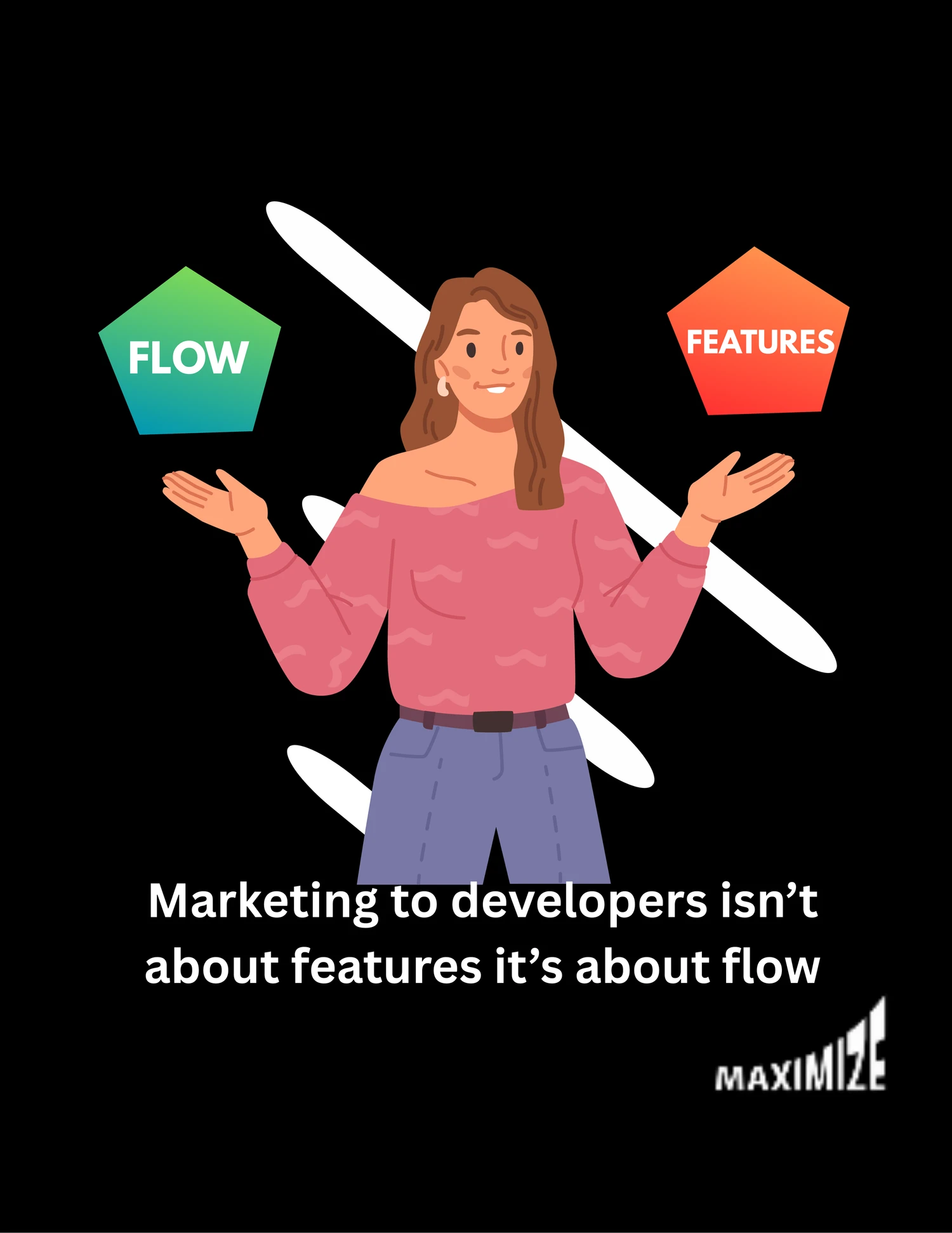
Developers don’t adopt tools because of features—they adopt them because of flow.
If your product interrupts their rhythm, breaks their environment, or slows them down, it doesn’t matter how feature-rich it is. On the flip side, if your tool slides seamlessly into how they already work—and makes it easier to build, test, or deploy—you win.
In this post, we’ll unpack why flow matters more than features when marketing to developers, what dev-first companies get right, and how to position your product in a way that feels more like momentum than marketing.
Developer flow is the uninterrupted, focused state developers enter when they’re immersed in problem-solving. It’s the “heads down, tabs flying, terminal glowing” kind of focus.
A great developer experience doesn’t break that flow—it amplifies it. It helps developers:
Stay in their editor or terminal
Reuse familiar patterns
Avoid context-switching
Move from idea → execution → output faster
When a tool feels like a natural extension of how developers already work, it clicks. That’s what you want your product to feel like.
When you lead with features, you're usually talking about what the product can do. But developers care about what they can do with it—and how easily.
Here’s how feature-first messaging can fail:
Too much cognitive overhead: “Now I need to learn this new CLI syntax and rebuild my config files.”
Out-of-context usage: “Cool feature, but I can’t use it in my stack.”
Feature overload: “Which part of this massive platform actually solves my one problem?”
🚫 Don’t just tell developers what your product does.
✅ Show them how it fits into their workflow and makes them faster.
Compare these two pitches for a hypothetical database platform:
🛑 Feature-first:
“We offer real-time replication, role-based access control, Postgres compatibility, and enterprise-grade durability.”
✅ Flow-first:
“Spin up a Postgres database in seconds. Connect from your CLI. Start building—no config, no boilerplate.”
Same product. Very different experience.
Traditional marketing maps to a funnel (awareness → interest → decision).
Developer marketing maps to flow states:
Dev Flow Stage
What They Need
What You Say
Discovery
“Can I try this without commitment?”
“Install via npm. Try it in your browser. No signup needed.”
First setup
“How fast can I see it working?”
“From install to first request in 90 seconds.”
Integration
“Does it fit into my stack?”
“Works with Next.js, Docker, AWS, and GitHub Actions out of the box.”
Iteration
“Can I debug and scale easily?”
“Real-time logs, local dev tools, and CLI support included.”
Collaboration
“Can my team use it too?”
“Share environments with one link. Git-based version control.”
Want to align your marketing with developer flow? Here’s how:
Lead with scenarios, not features:
“How to trigger async workflows using X”
“Replace 200 lines of glue code with one API call”
“Local dev environment in two CLI commands”
Let the content show how your tool reduces steps in the dev process.
Your docs are your funnel. A good doc isn’t just about syntax—it teaches by doing.
Start with a “Hello World” that runs in minutes
Offer real-world, framework-specific examples
Include “next step” nudges inside the docs (e.g., “Deploy this on Vercel”)
Great docs don’t brag. They get out of the way.
This is true product and marketing alignment: make the easiest path also the most valuable one.
Examples:
Auto-detect environments during setup
Offer one-click deploys or demo repos
Inline feedback when something goes wrong
The less thinking a dev has to do to get started, the more likely they’ll stick.
Interactive playgrounds (try the API before signup)
Live code snippets (copy-paste → run)
Short, searchable video walkthroughs (2–3 minutes, no intro fluff)
GitHub templates (starters, not just docs)
Meet developers in their build mode, not their browse mode.
Turso doesn’t just talk about low-latency data access. Their messaging focuses on developer flow:
“Run SQLite at the edge in 30 seconds.”
Then it drops you into a real CLI example—no wait, no pitch deck.
Vercel’s homepage leads with a workflow:
“Develop. Preview. Ship.”
Not a feature list. Not a security guarantee. Just the flow, visualized and frictionless.
Instead of listing tech specs, Bun leans on speed and simplicity:
“Install. Run. Done.”
Their positioning lives entirely inside a dev’s cognitive context.
In 2025, the best developer tools aren’t winning because of one killer feature—they’re winning because they remove blockers. They respect how developers think and work. They help devs go from idea to execution with as few keystrokes, tabs, and docs as possible.
So next time you sit down to write messaging, ask yourself:
“Am I selling a feature—or enabling flow?”
Because when developers feel momentum, they stick. And they share.
Explore more insights and stories from our recent work.